WASHINGTON (Feb. 26, 2026) -- The National Transportation Safety Board released a letter to lawmakers emphasizing the Board’s recommendations in the wake of last year’s deadly midair collision near Ronald Reagan Washington National Airport.
In a letter to leaders of the House Armed Services and Transportation and Infrastructure committees, NTSB Chairwoman Jennifer Homendy, along with board members Michael Graham, Tom Chapman and Todd Inman, said the proposed ALERT Act would not implement many NTSB recommendations, including one recommending the FAA mandate critical collision-warning technology known as ADS-B In. If this anti-collision technology was fully operational, it would have given both air crews in the DCA midair collision additional time and directional assistance in locating each other.
“Based on our evaluation of the ALERT Act, as introduced, while we believe that the bill would address a few of our recommendations,” the letter said, “we believe that many key provisions fall short of fully implementing all of the NTSB’s recommendations. This includes requiring all aircraft operating in airspace where ADS-B Out is required to also be equipped with ADS-B In.
“The NTSB values its working relationship with your committees, and we appreciate your shared commitment to aviation safety and to the families who lost loved ones on January 29, 2025,” the letter reads. “However, we cannot support the ALERT Act in its current form as it is not fully responsive to the NTSB’s recommendations.”
To take full advantage of the safety benefits provided by ADS-B, the NTSB recommends that the FAA require all aircraft operating in airspace where ADS-B Out is required to also be equipped with ADS-B In with a cockpit display of traffic information that is configured to provide alerting audible to the pilot and/or flight crew. To provide the same situational awareness advantages to military flight crews, the NTSB recommends that the Pentagon require all military aircraft operating in the national airspace be equipped with ADS-B In with a cockpit display that is configured to provide alerting audible to the pilot and/or flight crew, and that such requirement apply wherever the FAA requires any aircraft to operate with ADS-B Out.
“We conducted a year-long investigation, published over 19,000 pages of evidence in our public docket, and issued 74 findings and 50 recommendations aimed at preventing another tragedy and saving lives,” said Tim LeBaron, director of NTSB’s office of aviation safety. “Efforts to now water-down our evidence-based recommendations are counter to safety and dishonor the lives of 67 people who died on January 29, 2025.”
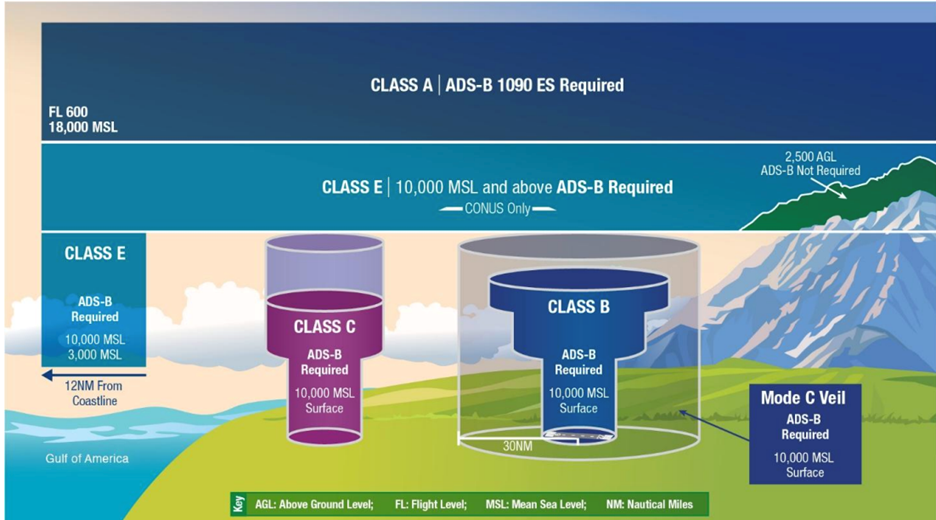
Since January 1, 2020, ADS-B Out is required on all aircraft in most controlled airspace within the national airspace as shown. This includes operations above 10,000 ft msl and within or above Class B and C airspace with certain exceptions.37 ADS-B In is currently not required by the FAA. (Source: FAA)
The NTSB has previously advocated for the FAA to require ADS-B In technology on the basis that equipping aircraft with ADS-B In capability would provide an immediate and substantial contribution to safety, especially near airports. ADS-B In information would enhance pilots’ situation awareness by providing information regarding traffic conflicts that may otherwise go undetected due to the numerous documented limitations of see-and-avoid.
In the DCA investigation, the NTSB performed a simulation to determine how an ADS-B based system would have performed in the accident scenario. The simulation indicated that the crew of American Airlines flight 5342 would have received two alerts concerning the Army UH-60L helicopter had it been equipped with such a system. The first aural and visual alert would have occurred 59 seconds before the collision, annunciating, “Traffic, 12 o’clock, low, three miles, descending.” A second aural alert would have occurred 35 seconds before the collision, annunciating, “Traffic, 12 o’clock, low, two miles.”
The NTSB also released Thursday
a side-by-side comparison of the ALERT Act and NTSB recommendations. A similar document was shared with congressional staff earlier this week, part of the NTSB’s technical assistance to committees of jurisdiction.
The
final report, along with the full set of recommendations and other information, is available at ntsb.gov.
To report an incident/accident or if you are a public safety agency, please call 1-844-373-9922 or 202-314-6290 to speak to a Watch Officer at the NTSB Response Operations Center (ROC) in Washington, DC (24/7).
