WASHINGTON (Feb. 4, 2021) – The National Transportation Safety Board said Thursday a ship carrying liquefied petroleum gas struck a Washington State wharf in 2019 because the pilot approached with excessive speed and at too steep an angle, resulting from poor bridge resource management by the Puget Sound pilot and the ship's bridge team.
The 741.5-foot partially loaded liquified gas carrier Levant struck the Petrogas Ferndale Wharf in Puget Sound, near Ferndale, Washington, on Dec. 15, 2019, causing more than $8 million in damage. The wharf's south mooring dolphin, and the catwalk connecting it to the wharf, were destroyed and the Levant's forward ballast tank was penetrated and flooded. There were no injuries or environmental damage.
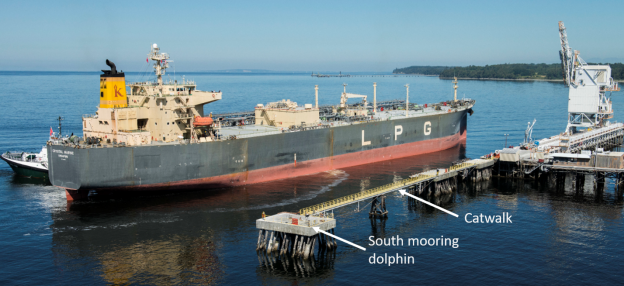
(In this undated image, a tanker of similar size to the Levant, is seen docking starboard side to the Petrogas Wharf in Ferndale, Washington. Photo courtesy of Petrogas LLC.)
The Levant, owned by Avance Gas LTD and operated by Exmar Ship Management NV, successfully docked at the wharf several days earlier. The master, concerned about maintaining a safe under-keel clearance due to a falling tide, decided to stop loading their cargo of propane and butane and take the ship to deeper water for the night. For the shift to the anchorage, 0.7 miles away, a pilot was brought on board. The pilot then stayed for the next day's early morning approach back to the wharf when tidal conditions improved.
Investigators found a “condition of complacency" likely existed on the bridge because of the short distance back to the wharf. The master-pilot exchange of information was not as detailed as during the earlier briefing before leaving the wharf. The pilot and the master were likely distracted by a two-minute, non-pertinent conversation they had about three minutes before contact.
In Marine Accident Brief 21/02, the NTSB said the vigilance of a pilot and bridge team should be increased, not decreased, with a ship's proximity to dangers and obstructions. Regardless of the distance or duration of a transit, the bridge resource management fundamentals of planning, communication, use of all available resources and information, monitoring and management of distractions are essential to operations with a pilot on board.
Marine Accident Brief 21/02 is available online at https://go.usa.gov/xASUg.
To report an incident/accident or if you are a public safety agency, please call 1-844-373-9922 or 202-314-6290 to speak to a Watch Officer at the NTSB Response Operations Center (ROC) in Washington, DC (24/7).
