Land-Based Firefighters: Know the Risks and Challenges Posed by In-Port Vessel Fires
The problem
Safety Alert Section 2 Title Many land based firefighters lack the necessary training and familiarity with vessel layouts and fire protection systems to effectively fight in-port vessel fires.
- Combatting vessel fires—especially aboard large commercial vessels—requires different resources, skills, and tactics than fighting structural fires on land.
- Shoreside firefighting focuses on extinguishing a fire, and marine firefighting focuses on containment.
- Although vessels have fire hydrants and hoses, water applied to a vessel fire can accumulate within the vessel and affect the vessel’s stability.
- Large vessels are primarily constructed of steel, which often reflects radio waves, making portable radios unusable.
- Land-based firefighters may be unaware how to leverage the structural fire protection that is built into most commercial vessels.
- Structural fire protection uses passive design features, such as fire-resistant bulkheads and decks, to slow the expansion of a fire from one compartment to another.
- The fire-resistant bulkheads and decks also divide the ship into fire protection zones that can be sealed to starve a fire of oxygen.
- Many ships have built-in fixed firefighting systems that use gas, such as carbon dioxide, in conjunction with a vessel’s fire protection zones, to displace oxygen and extinguish shipboard fires.
- The space in which these systems are activated must be sealed off: Opening the space too soon following the gas release can cause a reflash of the fire from the introduction of fresh air (oxygen).
- Once the suppression gas is released into the sealed area, it can be extremely hazardous to firefighters.
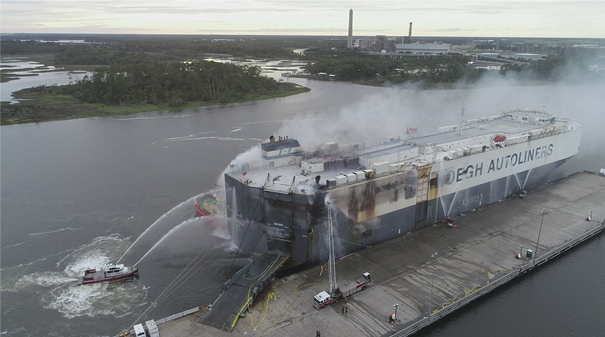 Figure 1. Firefighters conduct exterior boundary cooling on the Höegh Xiamen on June 5, 2021, the day after the fire was discovered. Boundary cooling involves using water deluge to keep bulkheads and decks cool to prevent the spread of fire through conduction and to prevent structural collapse, all while taking care to not flood the ship with firefighting water, which would risk sinking or capsizing the vessel. (Source: Jacksonville Fire and Rescue Department)
Related investigations
Safety Alert Section Content 3 The following NTSB investigations involved vessel fires that resulted in land based firefighter injuries due to the firefighters’ lack of training in vessel firefighting.
Safety Alert Section Content 5 On July 5, 2023, a vehicle caught fire on the roll-on/roll-off container vessel Grande Costa D’Avorio during cargo loading at Port Newark, New Jersey. While attempting to put out the fire, two land-based firefighters were unable to find their way out of one of the smoke-filled garage decks and died. Newark Fire Division leadership directed the firefighters to actively engage the fire in the fire protection zone where the extinguishing system had been activated, which allowed more carbon dioxide out and more oxygen in, increasing the severity of the fire. The Newark Fire Division’s lack of marine vessel firefighting training resulted in an ineffective response, led to the firefighter casualties, and contributed to the severity of the fire. DCA23FM039
Safety Alert Accordion Header Title On June 7, 2022, an engine room fire began aboard the sightseeing passenger vessel Spirit of Norfolk near Naval Station Norfolk, Virginia. Passengers and crew evacuated to a Good Samaritan vessel on scene. The Spirit of Norfolk was towed to a US Navy pier. The fire spread throughout the vessel before being extinguished 4 days later. Although there were no injuries, we found that the communications between the firefighting teams and the unified command were ineffective, and the fire attack team’s actions allowed the fire to spread beyond the initial fire protection zone. DCA22FM022
Safety Alert Accordion Title 1 The roll-on/roll-off vehicle carrier Höegh Xiamen caught fire on June 4, 2020, at the completion of cargo loading in Jacksonville, Forida. As the fire spread, land-based firefighters entered cargo decks with fire hoses. Nine firefighters were subsequently injured, five of them seriously, in an explosion, which occurred when they opened a cargo deck exhaust vent. The deck likely contained a rich atmosphere of heated flammable vapors, which rapidly combusted when fresh air was introduced via the opening. The fire was extinguished over a week later, on June 12. DCA20FM020
DCA23FM039
On July 5, 2023, a vehicle caught fire on the roll-on/roll-off container vessel Grande Costa D’Avorio during cargo loading at Port Newark, New Jersey. While attempting to put out the fire, two land-based firefighters were unable to find their way out of one of the smoke-filled garage decks and died. Newark Fire Division leadership directed the firefighters to actively engage the fire in the fire protection zone where the extinguishing system had been activated, which allowed more carbon dioxide out and more oxygen in, increasing the severity of the fire. The Newark Fire Division’s lack of marine vessel firefighting training resulted in an ineffective response, led to the firefighter casualties, and contributed to the severity of the fire. DCA23FM039
DCA22FM022
On June 7, 2022, an engine room fire began aboard the sightseeing passenger vessel Spirit of Norfolk near Naval Station Norfolk, Virginia. Passengers and crew evacuated to a Good Samaritan vessel on scene. The Spirit of Norfolk was towed to a US Navy pier. The fire spread throughout the vessel before being extinguished 4 days later. Although there were no injuries, we found that the communications between the firefighting teams and the unified command were ineffective, and the fire attack team’s actions allowed the fire to spread beyond the initial fire protection zone. DCA22FM022
DCA20FM020
The roll-on/roll-off vehicle carrier Höegh Xiamen caught fire on June 4, 2020, at the completion of cargo loading in Jacksonville, Forida. As the fire spread, land-based firefighters entered cargo decks with fire hoses. Nine firefighters were subsequently injured, five of them seriously, in an explosion, which occurred when they opened a cargo deck exhaust vent. The deck likely contained a rich atmosphere of heated flammable vapors, which rapidly combusted when fresh air was introduced via the opening. The fire was extinguished over a week later, on June 12. DCA20FM020
What can you do?
Safety Alert Section Title 5 The fire departments that serve ports can improve the safety of their firefighters and achieve better outcomes when responding to vessel fires by doing the following:
- Send personnel to an advanced shipboard firefighting training program to obtain familiarization with the specialized procedures and unique risks of fighting fires onboard vessels.
- Work with personnel to identify any areas they could improve in their operations while fighting fires onboard vessels.
- Develop shipboard firefighting standard operational procedures and train personnel on them.
- Develop training plans to ensure all firefighters understand how to fight vessel fires, including the resources needed, the best tactics, strategies and methods for communicating while on a vessel and with vessel crew, and vessel layouts.
- Work in advance with local ports to organize vessel familiarization tours and to coordinate vessel firefighting response preparedness and training in conjunction with the drills and exercises required for certain vessels under Title 33, Code of Federal Regulations, Section 155.4052.
- Learn from the circumstances of other in-port vessel fires to improve contingency planning.
- Provide your firefighters with available resources, such as the National Fire Protection Association (NFPA) firefighting standards.
- Identify supplemental training areas and develop a training plan and operational procedures in reference to NFPA 1405: Guide for Land-Based Fire Departments that Respond to Marine Vessel Fires, and NFPA 1010: Standard on Professional Qualifications for Firefighters (formerly NFPA 1005: Standards for Professional Qualifications for Marine Fire Fighting for Land- Based Fire Fighters).
- Coordinate with the US Coast Guard on standard operating procedures during emergencies.
Safety Alert_Section Title 6
Interested in more information?
Safety Alert Section Content 1
Coast Guard Marine Safety Alert 09-23 discusses the unique dangers of shipboard fires and the importance of local fire departments and port stakeholders working together to develop training and planning to prepare for vessel fires.
|
