More than 3 million miles of pipeline deliver important resources, like natural gas, to approximately 73 million residential customers and over 5 million commercial customers across the nation. Pipelines are one of the safest and most efficient means of transporting natural gas, but when a leak occurs, the consequences can be catastrophic. Early detection of a gas leak is critical. Natural gas alarms, or methane detectors, can warn people of dangerous gas levels allowing them to evacuate before an explosion occurs.
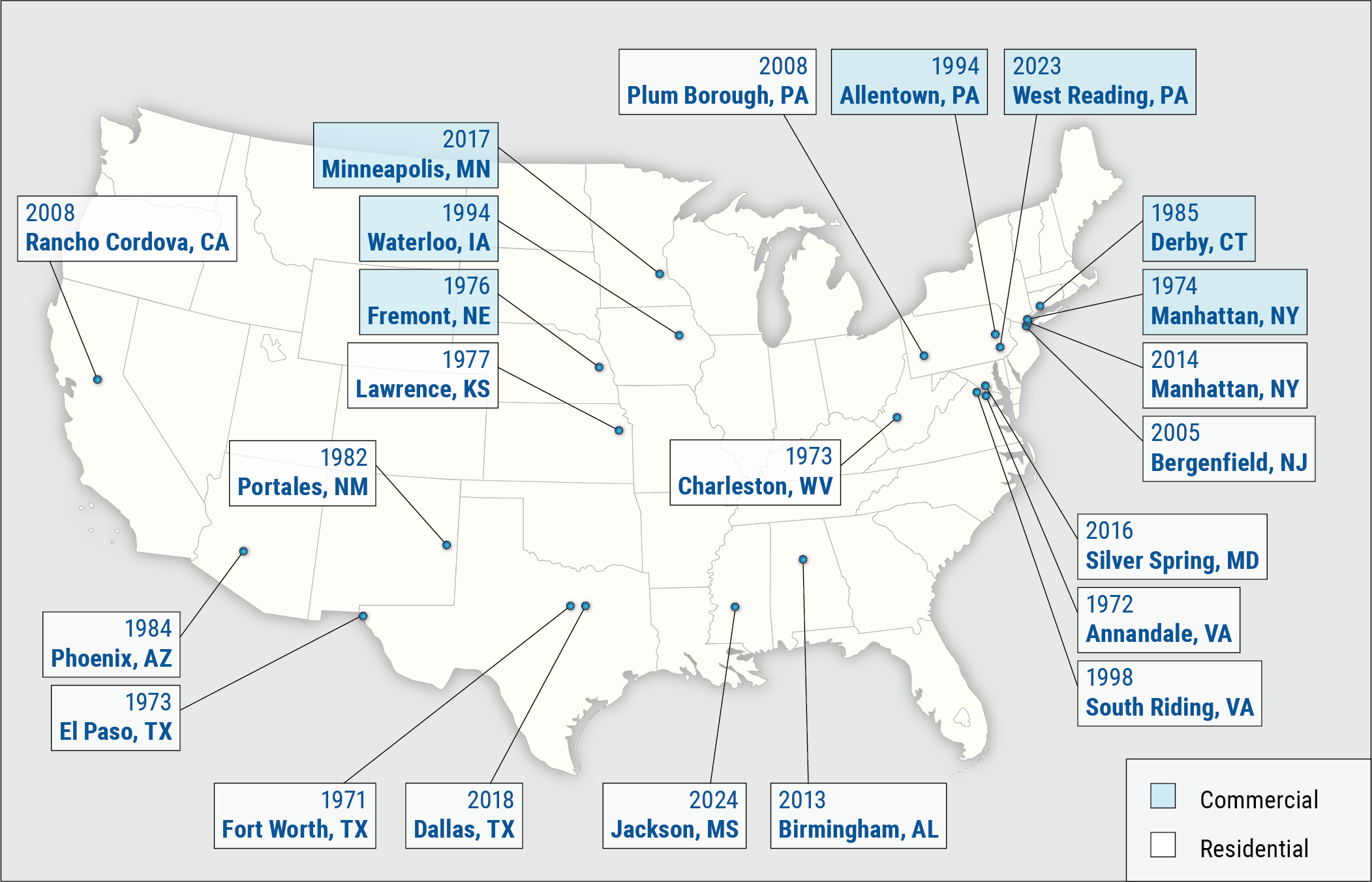
 NTSB Investigations of Residential and Commercial Building Pipeline Accidents 1971 to present
Why Odorants Are Not Enough
Natural gas is colorless and odorless and cannot be easily detected if it leaks and accumulates. To help people detect leaks, gas companies add odorants that smell like sulfur or rotten eggs. Unfortunately, odorants don’t always work:
- Some people cannot smell it, are sleeping, or do not know that the odorant is associated with natural gas.
- People may not be in the room or building where the natural gas is accumulating.
- Soil can strip the odorant from the gas, leaving it odorless again, if natural gas migrates through soil before entering a home or building.
That means a leak can be present, but completely undetectable by smell.
What Are Natural Gas Alarms?
Natural gas alarms are vital to the early detection of a natural gas leak. Natural gas alarms are safety devices that monitor the air for natural gas and sound an alarm, similar to a smoke detector, if they detect dangerous levels of natural gas. These devices can alert people to the presence of natural gas so that they can evacuate safely before an explosion occurs.
Open Recommendations that Represent Critical Safety Priorities
P-26-10 To Atmos Energy Corporation:Develop and implement a program that makes natural gas alarms available to members of the public who reside in your distribution areas.
P-25-5: To 50 States, the Commonwealth of Puerto Rico, and the District of Columbia: Require the installation of natural gas alarms that meet the specifications of National Fire Protection Association 715 in businesses, residences, and other buildings where people congregate that could be affected by a natural gas leak.
P-25-9: To the American Gas Association: Share the details of the March 24, 2023, natural gas–fueled explosion and fire in West Reading, Pennsylvania, with your members, encouraging them to evaluate the effectiveness of their current delivery methods of public awareness programs and to promote the installation of natural gas alarms in businesses, residences, and other places of congregation that they serve.
P-25-13: To the International Code Council: Revise the International Fuel Gas Code to provide for required installation of natural gas alarms that meet the specifications of National Fire Protection Association 715 for buildings that use natural gas.
P-25-15: To the National Fire Protection Association: Revise National Fire Protection Association 54 (the National Fuel Gas Code) to provide for required installation of natural gas alarms that meet the specifications of National Fire Protection Association 715 for buildings that use natural gas.
(P-21-2) To the Pipeline and Hazardous Material Safety Administration: Evaluate industry’s implementation of the gas distribution pipeline integrity management requirements and develop updated guidance for improving their effectiveness. The evaluation should specifically consider factors that may increase the likelihood of failure such as age, increase the overall risk (including factors that simultaneously increase the likelihood and consequence of failure), and limit the effectiveness of leak management programs.
P-19-6: To the International Code Council: In coordination with the Gas Technology Institute and the National Fire Protection Association, incorporate provisions in the International Fuel Gas Code that requires methane detection systems for all types of residential occupancies with gas service. At a minimum, the provisions should cover the installation, maintenance, placement of the detectors, and testing requirements.
P-19-7: To the National Fire Protection Association: In coordination with the Gas Technology Institute and the International Code Council, revise the National Fuel Gas Code, National Fire Protection Association 54 to require methane detection systems for all types of residential occupancies with gas service. At a minimum, the provisions should cover the installation, maintenance, placement of the detectors, and testing requirements.
Closed Recommedations
P-76-12: To the Department of Housing and Urban Development: Investigate the practicability and the availability of gas vapor detection instruments for installation at strategic locations in buildings. Based on the results of this investigation, recommend guidelines to appropriate state and local government agencies for regulations for the installation of gas detection instruments in buildings.
P-96-16: To the Department of Housing and Urban Development: Evaluate the safety benefits of using gas detectors in buildings approved by the Department for Federal Rent Subsidies as a means of providing building occupants and local emergency-response agencies with early notice of released natural gas within buildings; require that gas detectors be used in buildings in which the Department has determined that a gas detector would be cost effective and beneficial.
P-19-8: To the Gas Technology Institute: In coordination with the National Fire Protection Association and the International Code Council, work to develop standards for methane detection systems for all types of residential occupancies in both the International Fuel Gas Code and the National Fuel Gas Code, National Fire Protection Association 54. At a minimum, the provisions should cover the installation, maintenance, placement of the detectors, and testing requirements.
