Since the first fatal crash, in 2016 in Williston, Florida involving a vehicle with driving automation features engaged, the NTSB has investigated many crashes involving vehicles equipped with various driving automation features. Modern vehicles use many technologies to support the driving task, and their capabilities have become increasingly sophisticated. These advanced driver assistance systems (ADAS) can be limited to providing warnings (such as blind spot warnings) and momentary assistance (such as automatic emergency braking). Some systems provide steering support to the driver (such as lane centering) or brake/acceleration support (such as adaptive cruise control). Other systems offer partial driving automation, providing both steering and brake/acceleration support at the same time. Drivers must constantly supervise the driving environment and driver support features, stay alert, and be ready to take control at any time. The NTSB has also investigated incidents involving vehicles equipped with developmental automated driving systems (ADS) — those that can drive the vehicle under limited conditions— including robotaxi operations tested on public roads.
Our investigations underscore the need for data recording requirements, risk identification and mitigation strategies, and transparent safety evaluations to ensure that various driver assistance and vehicle automated driving systems—whether ADAS or ADS—are deployed safely.
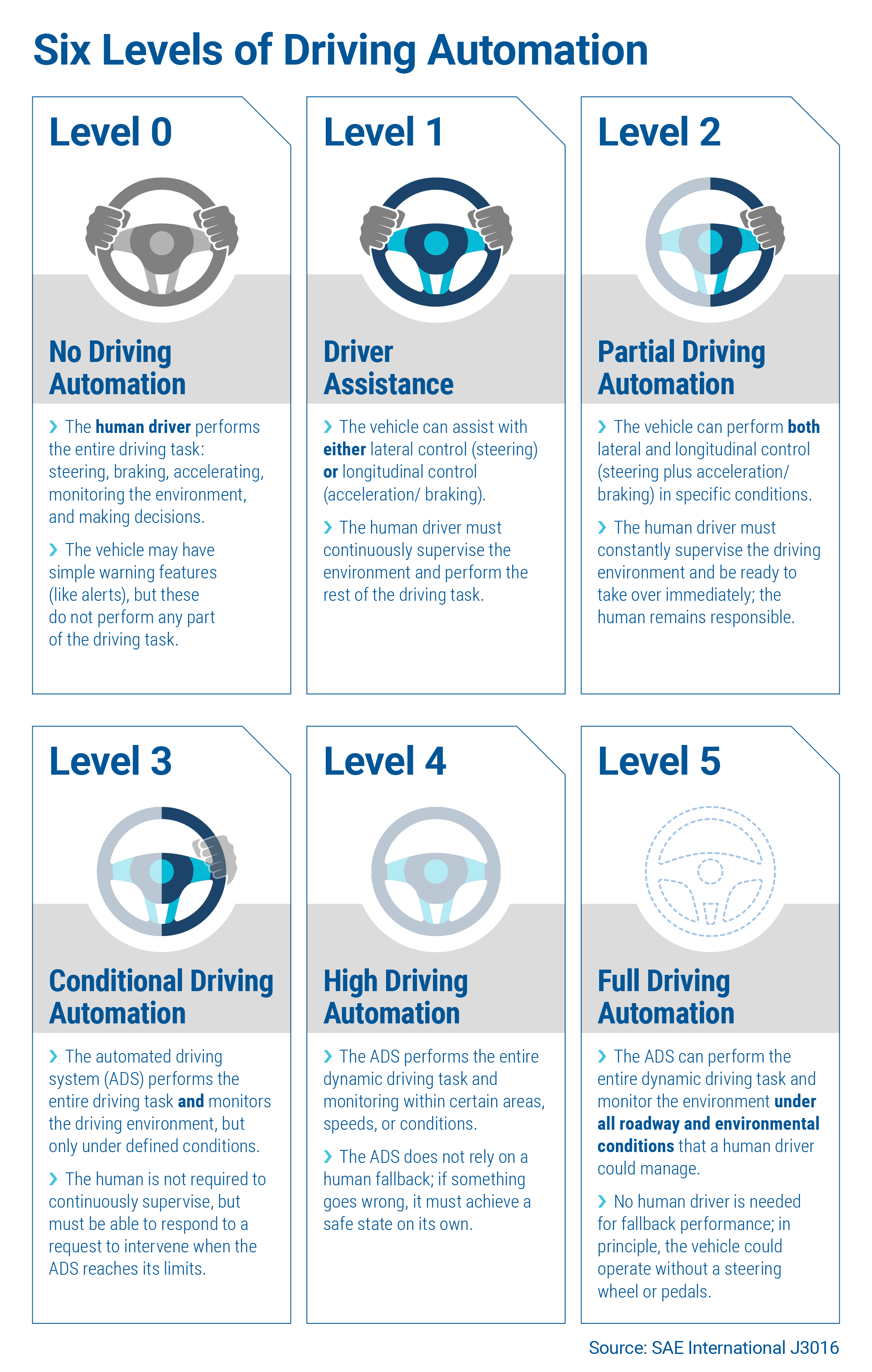
SAE J3016, defines six levels of driving automation, from Level 0 (no automation) to Level 5 (full automation), and current consumer vehicles are limited to driver assistance and partial automation features—such as adaptive cruise control, lane keeping assistance, and automatic emergency braking—that are designed to support, not replace, an attentive driver.
Open Recommendations Representing Critical Safety Priorities
To the US Department of Transportation:
H-26-1: Issue comprehensive guidelines for vehicle manufacturers implementing partial vehicle automation systems that address known system limitations, including:
- integration and concurrent engagement of other safety-critical technologies (such as automatic emergency braking, active intelligent speed assistance, and driver monitoring systems);
- promoting driver engagement by design;
- reducing the safety risks associated with automation complacency and misuse; and
- setting maximum operational speeds for automation systems based on overall system capabilities.
To the National Highway Traffic Safety Administration:
- H-26-2: Require manufacturers to equip new SAE Level 2-capable passenger vehicles with a telematic system that notifies the manufacturer of crashes meeting your reporting requirements in Standing General Order 2021-01.
-
H-26-3: Amend 49 Code of Federal Regulations Part 563, “Event Data Recorders,” to require that all new SAE Level 2-capable passenger vehicles record data elements related to these systems, including at a minimum:
- system availability;
- engagement and activation denial;
- driver alerts; and
- system faults for automatic emergency braking, forward collision warning, driver monitoring systems, lane departure prevention, lane centering, partial automation system operation, and any other systems deemed necessary.
-
H-26-4: Require that all new SAE Level 2-capable passenger vehicles be equipped with driver monitoring systems capable of minimizing driver disengagement, automation complacency, and misuse of vehicle automation by, at a minimum: providing warnings about accumulated short glances over a prolonged period of time; differentiating genuine on-road glances from attention directed to objects, such as cell phones, located in the driver’s forward line of sight; and issuing initial and subsequent multimodal alerts at intervals that minimize eyes-off-road duration.
-
H-20-002: Evaluate Tesla Autopilot-equipped vehicles to determine if the system’s operating limitations, the foreseeability of driver misuse, and the ability to operate the vehicles outside the intended operational design domain pose an unreasonable risk to safety; if safety defects are identified, use applicable enforcement authority to ensure that Tesla Inc. takes corrective action. (Open – Acceptable Response)
-
H-20-10: When evaluating safety self-assessment reports from entities testing automated driving systems on public roads, evaluate how effectively the entities include school bus operations in their plans. (Open-Unacceptable Response)
-
H-19-47: Require entities who are testing or who intend to test a developmental automated driving system on public roads to submit a safety self-assessment report to your agency. (Open – Unacceptable Response)
-
H-19-48: Establish a process for the ongoing evaluation of the safety self-assessment reports as required in Safety Recommendation H-19-47 and determine whether the plans include appropriate safeguards for testing a developmental automated driving system on public roads, including adequate monitoring of vehicle operator engagement, if applicable. (Open – Unacceptable Response)
- H-17-38: Develop a method to verify that manufacturers of vehicles equipped with Level 2 vehicle automation systems incorporate system safeguards that limit the use of automated vehicle control systems to those conditions for which they were designed.
To the States:
-
H-19-49: To the State of Arizona: Require developers to submit an application for testing ADS-equipped vehicles that, at a minimum, details a plan to manage the risk associated with crashes and operator inattentiveness and establishes countermeasures to prevent crashes or mitigate crash severity within the ADS testing parameters. (Open – Await Response)
-
H-19-50: To the State of Arizona: Establish a task group of experts to evaluate applications for testing vehicles equipped with automated driving systems, as described in Safety Recommendation H-19-49, before granting a testing permit. (Open – Await Response)
To Vehicle Manufacturers:
-
H-26-5: To the Ford Motor Company: Revise the driver monitoring systems (DMS) in your new vehicles to detect and provide warnings about accumulated short distractions over a prolonged period of time; differentiate genuine driver on-road glances from attention directed to objects, such as cell phones, located in the driver’s forward line of sight; and issue initial and subsequent multimodal alerts at intervals that minimize eyes-off-road duration.
-
H-26-6: To the Ford Motor Company: Modify your BlueCruise system for new vehicles to require that the automatic emergency braking system is engaged and that the Intelligent Adaptive Cruise Control system uses appropriate speed tolerances to mitigate excessive speeding, taking into consideration the system’s operational capabilities as well as traffic and highway complexity.
-
H-17-41: To the manufacturers of vehicles equipped with Level 2 vehicle automation systems (Volkswagen Group of America, BMW of North America, Nissan Group of North America, Mercedes-Benz USA, Tesla Inc., and Volvo Group North America): Incorporate system safeguards that limit the use of automated vehicle control systems to those conditions for which they were designed. (Open – Acceptable Action)
-
H-17-42: To the manufacturers of vehicles equipped with Level 2 vehicle automation systems (Volkswagen Group of America, BMW of North America, Nissan Group of North America, Mercedes-Benz USA, Tesla Inc., and Volvo Group North America): Develop applications to more effectively sense the driver’s level of engagement and alert the driver when engagement is lacking while automated vehicle control systems are in use. (Open – Acceptable Response)
Updated April 21, 2026
