Seat Restraints: Small Component, Critical Protection
The Problem
Safety Alert Section 2 Title Serious or fatal injuries can happen during aviation accidents when restraints (lap belts or shoulder harnesses) experience a failure or are not installed. General aviation aircraft restraints may degrade due to UV exposure, age, and repeated use. Therefore, it is important for pilots and mechanics to frequently inspect restraint systems and become aware of best practices to ensure their safe condition.
Additionally, some general aviation aircraft use restraint systems that were manufactured to lower-strength standards than other available restraint systems manufactured to an updated standard. Restraints manufactured in accordance with Technical Service Order (TSO)-C22f, issued in May 1972, have a rated strength of 1,500 lbs for the lap belt restraint system. In 1993, the FAA issued TSO-C22g, a revision to TSO-C22f, which revised the minimum performance requirements for safety belts and incorporated updated performance criteria. TSO-C22f required the strength of restraint systems to be 3,000 lbs for lap belts and 2,500 lbs for shoulder harnesses. The FAA strengthened these requirements to better account for dynamic human Side-by-side photographs from two different airplanes showing examples of webbing labels identifying a lower-rated assembly strength of 1,500 lbs (left) and the higher-rated assembly strength of 3,000 lbs (right). movement and upper torso forces. However, due to economic reasons, the FAA permitted restraint systems approved before TSO-C22g to remain in production under the terms of their original approval for small aircraft weighing 12,500 lbs or less. As a result, pilots and mechanics may unknowingly be using safety restraint systems that may offer a lower level of protection during an accident than systems that comply with the enhanced performance requirements of TSO-C22g.
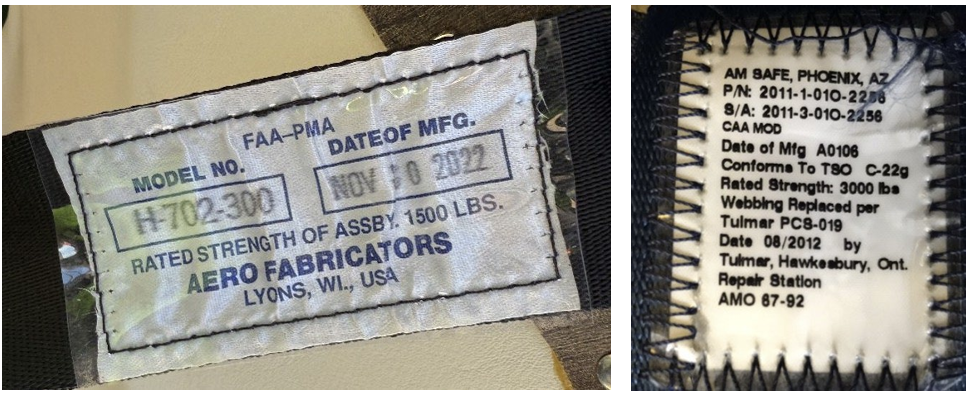
Side-by-side photographs from two different airplanes showing examples of webbing labels identifying a lower-rated assembly strength of 1,500 lbs (left) and the higher-rated assembly strength of 3,000 lbs (right).
What can owners and operators do?
Safety Alert Section 3 Title - Be aware that restraint systems with lower strength ratings may meet applicable requirements; however, higher-rated restraint systems may provide greater protection during an accident.
- Replace any restraints rated below 3,000 lbs for a lap belt and 2,500 lbs for a shoulder harness or whose strength rating cannot be verified because its label or markings are missing or unreadable.
- Have the restraints examined by a mechanic or the manufacturer if you are unsure of how to check the rated strength of your restraints.
- Perform routine preflight and annual visual inspections of both the shoulder and lap belt restraints for signs of wear, deformation, discoloration, defects, or fraying. For systems that involve a Y-junction shoulder harness, give special attention to the condition and threading on the Y junction that separates the two shoulder straps, and replace restraints, if necessary, to comply with the requirements of TSO-C22g.
- Upper torso restraint failure on Aeronca 7CCM, N308ED. For systems that involve a Y-junction shoulder harness, give special attention to the condition and threading on Example of an intact shoulder harness Y junction, showing no evidence of separation, tearing, or failure in stitching. the Y junction that separates the two shoulder straps, and replace restraints, if necessary, to comply with the requirements of TSO-C22g.
- Install shoulder harnesses if your airplane was designed without them. Follow an FAA-approved method such as the applicable supplemental type certificate (STC) or other acceptable methods of approval.
| 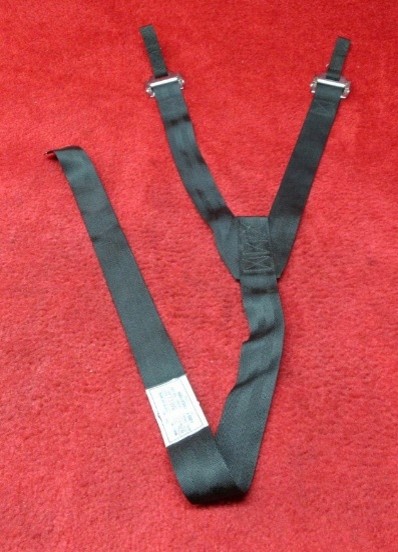 Example of an intact shoulder harness Y junction, showing no evidence of separation, tearing, or failure in stitching. |
What can mechanics do?
Safety Alert Section Title 4 - Inform owners of the available options to replace restraint systems on their aircraft.
- Recognize the signs of an aging restraint system—cut or worn edges, damaged stitching, broken threads, UV damage, and/or any excessive wear—that indicate the system may not meet its original design standards.
- Encourage owners of aircraft not equipped with shoulder harnesses to install them per the applicable STC or other acceptable methods of approval.
Related Investigations
Safety Alert Section Content 3 The NTSB has investigated several accidents in which restraints failed under crash loads. Three representative accidents are summarized below.
Safety Alert Section Content 5 On April 18, 2023, a Cessna 172N, N734GB, was substantially damaged when it was involved in an accident near Madison County Airport (UYF), London, Ohio. The flight instructor and student pilot died. Postaccident examination revealed a separation of the threading at the connection to the airframe of the upper torso restraint. Both seats had a three-point restraint system with a rated assembly strength of 1,500 lbs and were repaired on January 21, 2022. (ERA23FA200)
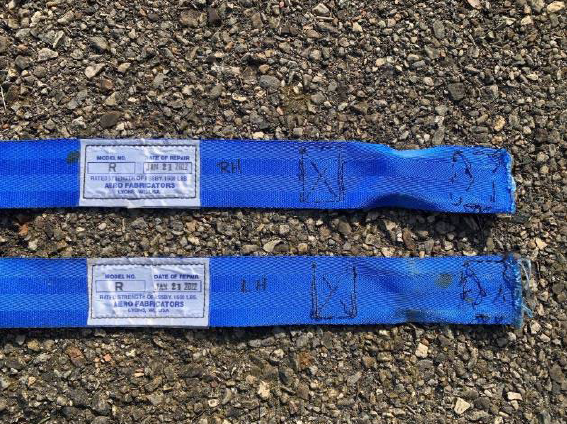
Cessna 172N, N734GB, front seat upper torso harnesses failed stitching.
Safety Alert Accordion Header Title On April 30, 2005, a commercial pilot died when his Taylorcraft F-19 airplane impacted terrain after takeoff and his shoulder harness failed. The passenger’s restraint system remained intact, and she sustained serious injuries. Examination of the pilot’s shoulder harness revealed features consistent with a previous overload tensile failure, which reduced the capability of the shoulder harness to provide adequate occupant protection. (ANC05FA070)
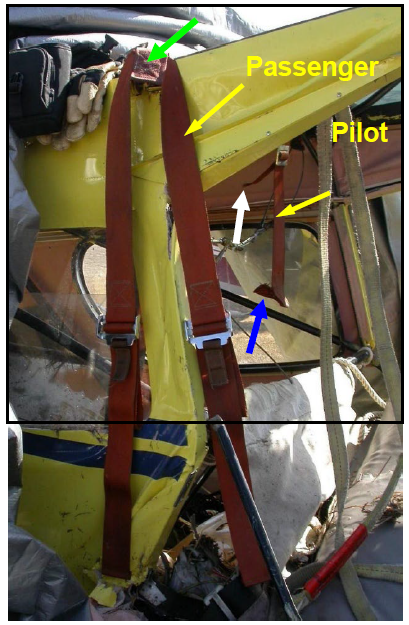
Intact right side passenger harness and left side pilot failed upper torso of the Taylorcraft F-19.
Safety Alert Accordion Title 1 On June 21, 2023, a pilot and passenger were fatally injured when an Aeronca 7CCM, N308ED, was substantially damaged during an accident near Duluth, Minnesota. On scene wreckage documentation noted that the threading at the connection to the airframe of the upper torso restraint was separated, and both shoulder webbings were separated at the Y-junction threading. The restraints were manufactured in 2009 with a rated assembly strength of 1,500 lbs. ( CEN23FA248) Upper torso restraint failure on Aeronca 7CCM, N308ED .
ERA23FA200
On April 18, 2023, a Cessna 172N, N734GB, was substantially damaged when it was involved in an accident near Madison County Airport (UYF), London, Ohio. The flight instructor and student pilot died. Postaccident examination revealed a separation of the threading at the connection to the airframe of the upper torso restraint. Both seats had a three-point restraint system with a rated assembly strength of 1,500 lbs and were repaired on January 21, 2022. (ERA23FA200)
Cessna 172N, N734GB, front seat upper torso harnesses failed stitching.
ANC05FA070
On April 30, 2005, a commercial pilot died when his Taylorcraft F-19 airplane impacted terrain after takeoff and his shoulder harness failed. The passenger’s restraint system remained intact, and she sustained serious injuries. Examination of the pilot’s shoulder harness revealed features consistent with a previous overload tensile failure, which reduced the capability of the shoulder harness to provide adequate occupant protection. (ANC05FA070)
Intact right side passenger harness and left side pilot failed upper torso of the Taylorcraft F-19. CEN23FA248
On June 21, 2023, a pilot and passenger were fatally injured when an Aeronca 7CCM, N308ED, was substantially damaged during an accident near Duluth, Minnesota. On scene wreckage documentation noted that the threading at the connection to the airframe of the upper torso restraint was separated, and both shoulder webbings were separated at the Y-junction threading. The restraints were manufactured in 2009 with a rated assembly strength of 1,500 lbs. ( CEN23FA248) Upper torso restraint failure on Aeronca 7CCM, N308ED .
Interested in more information?
Safety Alert Section Title 5
|
