Know the Risk of Working Near Live Tracks


The Problem

​​​​​​​​​​​​​Railroad conductors face the risk of death or injury when working near live tracks with authorized train movements. When inspecting or preparing railcars for movement, conductors often need to exit the train and work on the ground near adjacent live tracks, sometimes only a few feet away. This work is dangerous because conductors can accidentally foul the live tracks and be struck by a passing train.

Federal regulations require railroads to protect roadway workers through on-track safety programs under Title 49 Code of Federal Regulations (CFR) Part 214, Subpart C. These rules require roadway workers to establish protections such as exclusive track occupancy when fouling controlled tracks (49 CFR 214.321) and to follow on-track safety procedures on adjacent controlled tracks when working on the ground with on-track equipment (49 CFR 214.336).

Conductors and other operating employees, however, are not subject to the same federal on-track safety requirements as roadway workers when they exit a train to work on or near the track. As a result, conductors often work near adjacent live tracks without the protection commonly required for roadway workers. This safety alert urges railroads to require conductors to follow on-track safety procedures, such as establishing exclusive track occupancy on adjacent tracks, when working near live tracks.​


Related investigations

​Two recent investigations highlight the dangers of working near live tracks. In both cases, the conductors accidentally fouled adjacent live tracks while working nearby and were fatally struck by passing trains.

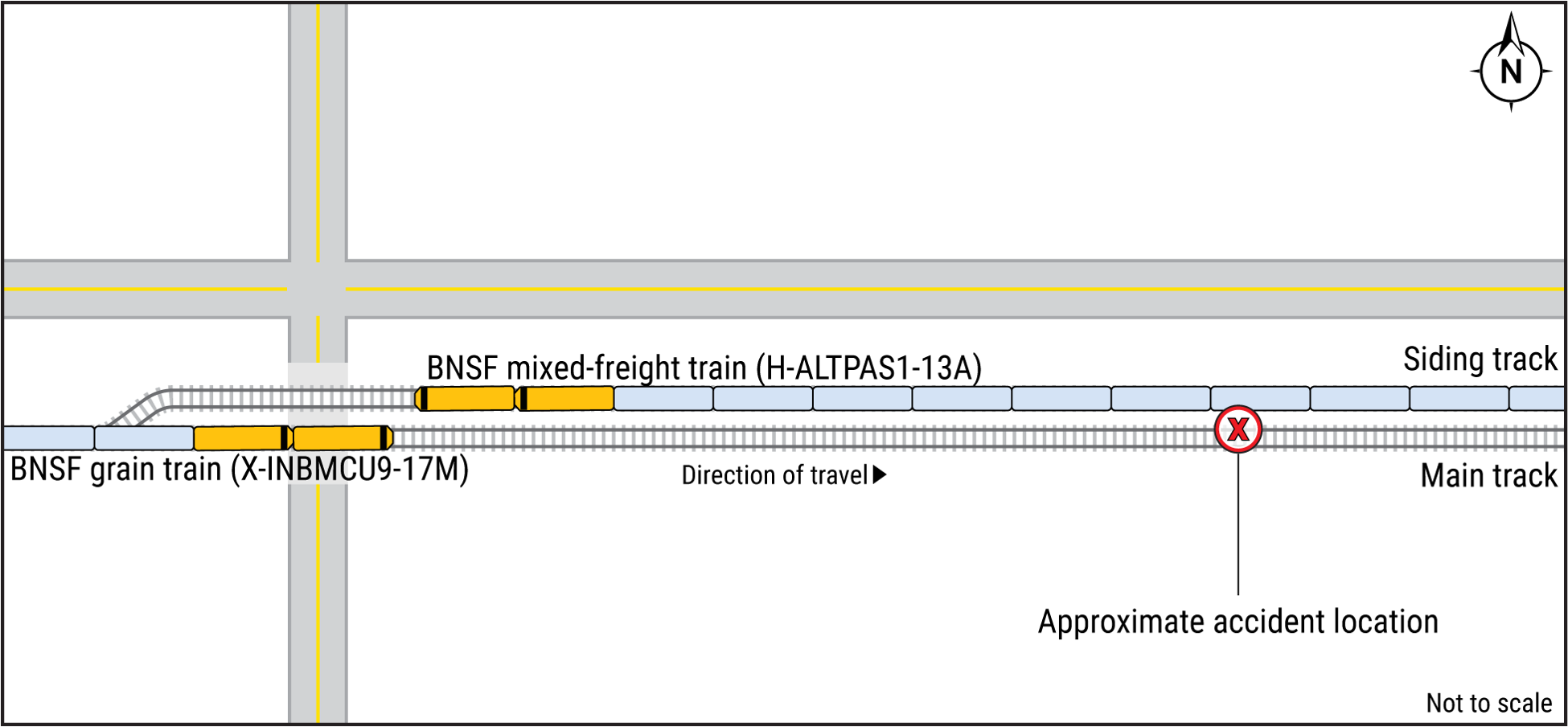
  • ​ On October 19, 2025​, about 9:32 a.m. local time, the conductor of a westbound BNSF Railway (BNSF) mixed-freight train (H-ALTPAS1-13A) was fatally struck by an eastbound BNSF grain train (X-INBMCU9-17M) in Columbus, Montana. The mixed-freight train was on the siding track, north of the main track. Immediately before the accident, the conductor was on the ground between the siding and the main track releasing hand brakes on the railcars of the mixed-freight train. The grain train was traveling about 37 mph on the adjacent main track. When the grain train engineer saw the conductor, he sounded his horn and initiated an emergency brake application. The NTSB’s review of forward-facing camera footage showed that the conductor was in the foul of the main track when he was struck.


​​​Diagram of the accident in Columbus, Montana.

  • On September 4, 2024, about 12:11 p.m. local time, the conductor of a northbound Union Pacific Railroad freight train (MCHAL-04) was fatally struck by a southbound METRA commuter train (M338) near Kenosha, Wisconsin. The freight train was traveling on main track 1 when it passed a wayside hot bearing detector, which detected an overheated wheel bearing on one of the railcars. The conductor dismounted the locomotive on the side of adjacent main track 2 to inspect the suspected hot wheel. He then crossed main track 2 and stood at the end of the crossties outside the gauge of the track as the METRA passenger train appoached the track at 54 mph. When the METRA operator saw the conductor about 670 feet ahead, he sounded the horn and initiated an emergency brake application but was not able to stop the train before striking the conductor. 
    ​Diagram of the accident near Kenosha, Wisconsin.


What can railroads do?

  • ​​Require conductors, before working on the ground on a stopped train, to brief with the dispatcher for awareness of trains scheduled to pass on adjacent tracks.
  • Create awareness through training, safety bulletins, and job briefings that conductors can put themselves in great danger by accidentally fouling an adjacent live track while working on the ground.
  • Modify existing rules and empower conductors to request track protection when they are working near live tracks.
  • Require conductors to carry and monitor a portable radio to receive updated information from the dispatcher and the train crew regarding train movement on adjacent tracks.
  • Direct supervisors to remind employees of the hazards of fouling live tracks, especially when the live tracks are adjacent to the work area.
  • Reinforce with conductors the hazards of working near live tracks through posters, stickers, or other visual cues placed in strategic locations.
  • Encourage employees to monitor one another’s activities to make sure they are paying attention and following instructions to reduce risk of injury.
  • Review and strengthen operating procedures for conductors working near live tracks.


What can conductors and other operating employees do?

  • ​Avoid working near live tracks when possible.
  • Stay (or work) on the side of the train away from the live track if there is a choice.
  • Stay vigilant and expect train movement on any track, at any time, from any direction.
  • Obtain information from the dispatcher about scheduled trains for tracks near where you will be working. 
  • Carry a portable radio to receive communications from the dispatcher and the train crew regarding train movements on adjacent tracks near where you are working.


Useful Terminology

​Foul a track​ 

A track is fouled when an individual or equipment is in the gauge of the track or within 4 feet of the nearest rail of the track and can be struck by a moving train or on-track equipment.

Gauge

The gauge of a track is the area between the two rails of the track.

Roadway Worker

A roadway worker is a railroad employee or contractor whose duties include inspection, construction, maintenance, or repair of railroad tracks, signal and communication systems, or roadway maintenance machines.

Exclusive track occupancy 

Exclusive track occupancy is a method of establishing working limits on controlled tracks.

Working limits 

Working limits are a segment of track with definite boundaries upon which trains may move only as authorized by the roadway worker having control over that defined segment of track.

Controlled track

Controlled track is a track upon which the movement of trains must be authorized by a train dispatcher or control operator.

Adjacent controlled track

Adjacent controlled track is a controlled track whose track center is spaced 19 feet or less form the track center of the occupied track.


Interested in More Information?

​Review NTSB’s previous Safety Alert on “Fouling Other Railroad Tracks”

​NTSB Safety Alert 78 / Fouling Other Railroad Tracks


​​​​​​