School District Checklist: Charter the Safest Vehicles
Safety Alert Section 2 Title School districts have a responsibility to provide safe transportation at all times, including when chartering a vehicle to transport students to athletic events or off-campus extracurricular activities.
Chartered vehicles, including motorcoaches, other large buses, small buses, and vans, differ from school buses; they meet different design standards and operational requirements. To achieve a high level of safety, school districts should select a passenger carrier that:
- Maintains a record of safe operations and compliance with safety regulations such as driver qualifications.
- Has passenger lap/shoulder belts for all seating positions.
- Conducts pre-trip safety briefings on the vehicle’s safety features, such as emergency exits and fire extinguishers, properly wearing the lap/shoulder belts, and what to do in an emergency.
The problem
Safety Alert Section 3 Title NTSB investigations into bus crashes have shown that deaths and serious injuries have resulted when available lap/shoulder belts were not used or were unavailable (such as on older buses), or when pre-trip safety briefings were not given.
In 2016, the National Highway Traffic Safety Administration (NHTSA) mandated lap/shoulder belts on buses in response to NTSB safety recommendations—a safety measure we have been advocating since 1968. Despite this mandate, not all buses on the road today are equipped with lap/shoulder belts, as older models were often not equipped with belts. NTSB investigations continue to demonstrate the importance of wearing lap/shoulder belts and choosing buses or other vehicles that have them installed. Operators must also provide pre-trip safety briefings to ensure passengers understand how to properly locate emergency exits and use safety equipment.
- Between 2012 and 2022, 108 bus occupants died in crashes involving motorcoaches, according to the Federal Motor Carrier Safety Administration (FMCSA).
- Passengers who do not wear seat belts face higher risk of serious or fatal injury, or can even be ejected, during a crash or rollover.
- According to NHTSA, the installation of lap/shoulder belts on large buses (gross vehicle weight rating above 26,000 pounds) and motorcoaches can “reduce the risk of fatal injuries in rollover crashes by 77 percent, primarily by preventing occupant ejection,” but only if the belts are worn properly.
- Pre-trip safety briefings providing information on the proper use of seat belts, locations of emergency exits, and locations and use of emergency equipment are not always provided by the driver.
Related investigations
Safety Alert Section Content 3 The NTSB’s investigations highlight the importance of proper lap/shoulder belt use and pre-trip safety briefings for passengers.
Safety Alert Section Content 5 A tractor-trailer was traveling west on Interstate 70 when it approached a traffic queue from an earlier minor crash. The driver did not slow and crashed into the rear of the traffic queue at about 72 mph. The resulting chain-reaction collision and postcrash fire involved five vehicles, including a bus chartered by a school district carrying 52 school students and 3 faculty members on a school trip. As a result of the crash, 3 bus occupants died, 3 were seriously injured, and 36 had minor injuries; 3 occupants of other vehicles also died. The bus was not equipped with passenger seatbelts (lap or lap/shoulder belts) because at the time it was built, these belts were not required by Federal Motor Vehicle Safety Standards. According to later interviews, the bus driver did not conduct a pre-trip safety briefing as required by the bus company’s driver handbook. HWY24MH001 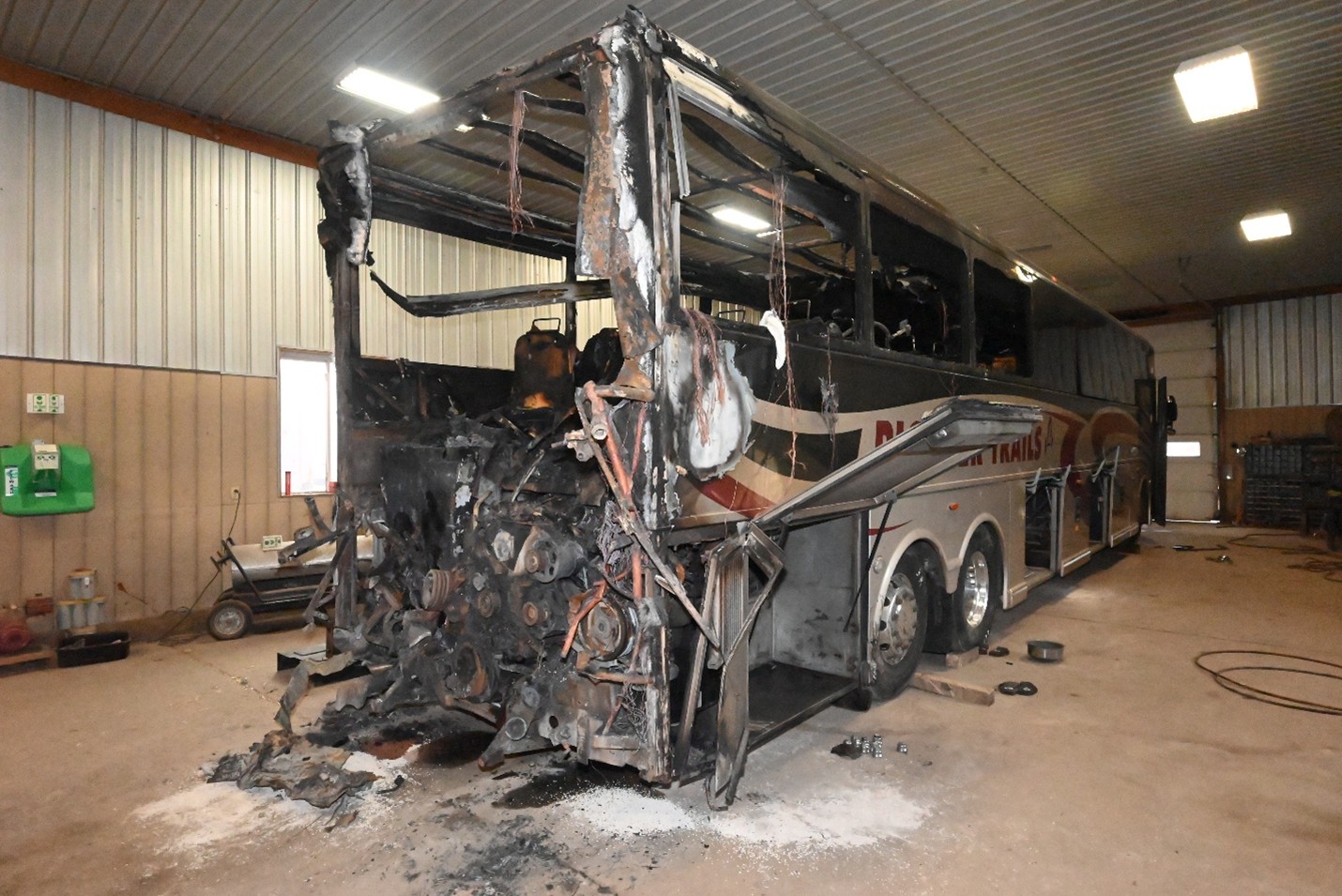 Damage to right rear of motorcoach. Damage to right rear of motorcoach.
Safety Alert Accordion Header Title A bus chartered by a New York school district to transport students to a band camp in Pennsylvania was traveling west on Interstate 84 when its left-front (steer) tire failed. As a result of the tire failure, the bus crossed the left lane and shoulder, penetrated a roadside cable barrier, traveled down into the median, and rolled before coming to rest on its left side. The bus was occupied by the driver, 40 high school students, and 3 adult chaperones. Two chaperones were ejected and died. The driver was ejected and seriously injured, 14 other occupants sustained serious injuries, and 27 had minor injuries. The 2014 bus was equipped with lap/shoulder belts in all seating positions, but only one passenger was belted at the time of the crash. The driver, who also was not belted, stated that she did not provide a pre-trip safety briefing and that the school had not requested one. HWY23FH016
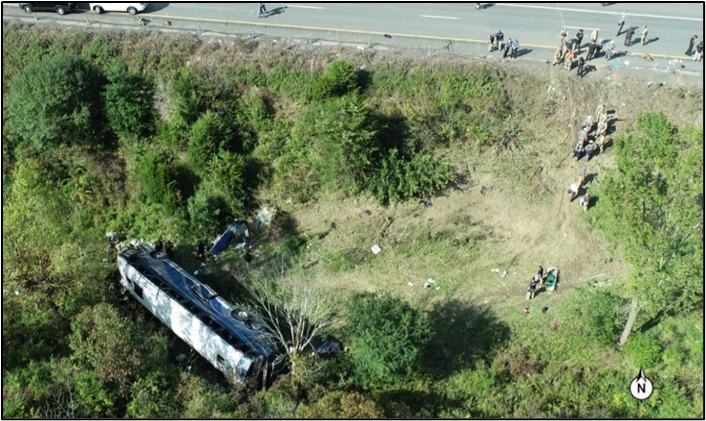 Aerial view of the motorcoach at final rest on its left side at the bottom of the median. (Source: New York State Police) Aerial view of the motorcoach at final rest on its left side at the bottom of the median. (Source: New York State Police)
Safety Alert Accordion Title 1 A truck-tractor combination vehicle was traveling south on Interstate 5 when it crossed the center median and collided with a passenger vehicle traveling north. The truck-tractor continued south in the northbound lanes and collided head-on with a bus that was chartered to transport high school students and adult chaperones to a California university. A postcrash fire ensued, making it difficult for the bus passengers to escape. The truck-tractor driver, the bus driver, and 8 bus passengers died. The remaining 37 bus passengers sustained injuries of varying degrees, and the 2 occupants of the passenger vehicle sustained minor injuries. The bus driver did not play the bus company’s prerecorded safety briefing, which showed where to find the bus emergency exits and fire extinguishers. The passengers were also not informed of the available lap/shoulder belts. Only one passenger was wearing a lap/shoulder belt. HWY14MH009
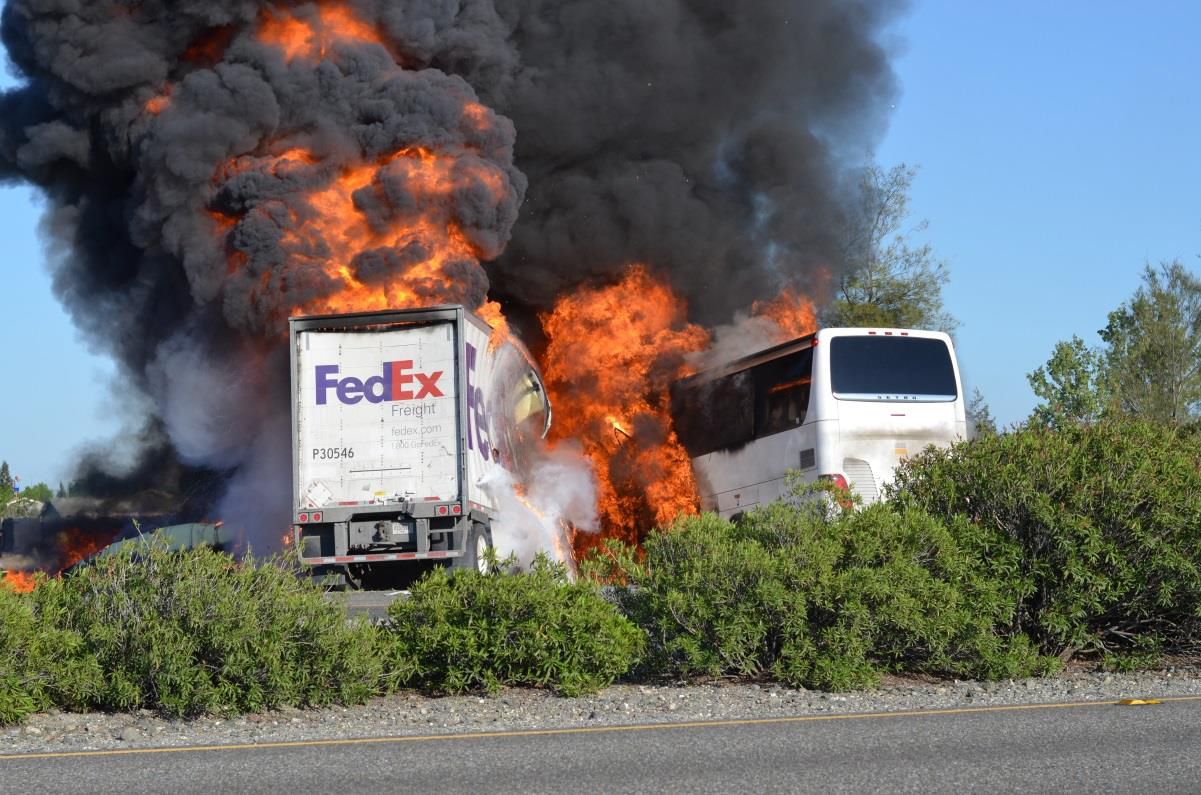 FedEx Freight truck-tractor double trailers and Silverado motorcoach postcrash. (Source: J. Lockett) FedEx Freight truck-tractor double trailers and Silverado motorcoach postcrash. (Source: J. Lockett)
Etna, Ohio (November 14, 2023)
A tractor-trailer was traveling west on Interstate 70 when it approached a traffic queue from an earlier minor crash. The driver did not slow and crashed into the rear of the traffic queue at about 72 mph. The resulting chain-reaction collision and postcrash fire involved five vehicles, including a bus chartered by a school district carrying 52 school students and 3 faculty members on a school trip. As a result of the crash, 3 bus occupants died, 3 were seriously injured, and 36 had minor injuries; 3 occupants of other vehicles also died. The bus was not equipped with passenger seatbelts (lap or lap/shoulder belts) because at the time it was built, these belts were not required by Federal Motor Vehicle Safety Standards. According to later interviews, the bus driver did not conduct a pre-trip safety briefing as required by the bus company’s driver handbook. HWY24MH001 Damage to right rear of motorcoach.
Wawayanda, New York (September 21, 2023)
A bus chartered by a New York school district to transport students to a band camp in Pennsylvania was traveling west on Interstate 84 when its left-front (steer) tire failed. As a result of the tire failure, the bus crossed the left lane and shoulder, penetrated a roadside cable barrier, traveled down into the median, and rolled before coming to rest on its left side. The bus was occupied by the driver, 40 high school students, and 3 adult chaperones. Two chaperones were ejected and died. The driver was ejected and seriously injured, 14 other occupants sustained serious injuries, and 27 had minor injuries. The 2014 bus was equipped with lap/shoulder belts in all seating positions, but only one passenger was belted at the time of the crash. The driver, who also was not belted, stated that she did not provide a pre-trip safety briefing and that the school had not requested one. HWY23FH016
Aerial view of the motorcoach at final rest on its left side at the bottom of the median. (Source: New York State Police)
Orland, California (April 10, 2014)
A truck-tractor combination vehicle was traveling south on Interstate 5 when it crossed the center median and collided with a passenger vehicle traveling north. The truck-tractor continued south in the northbound lanes and collided head-on with a bus that was chartered to transport high school students and adult chaperones to a California university. A postcrash fire ensued, making it difficult for the bus passengers to escape. The truck-tractor driver, the bus driver, and 8 bus passengers died. The remaining 37 bus passengers sustained injuries of varying degrees, and the 2 occupants of the passenger vehicle sustained minor injuries. The bus driver did not play the bus company’s prerecorded safety briefing, which showed where to find the bus emergency exits and fire extinguishers. The passengers were also not informed of the available lap/shoulder belts. Only one passenger was wearing a lap/shoulder belt. HWY14MH009
FedEx Freight truck-tractor double trailers and Silverado motorcoach postcrash. (Source: J. Lockett)
What can school districts do?
Safety Alert Section Title 5 School District Checklist: Selecting a Safe Passenger Carrier
- Review the safety record of the passenger carrier before you hire them.
- Obtain the operator’s company name and
USDOT number.
- Enter the name and USDOT number into the FMCSA’s
Passenger Carrier Search by Company tool and check that the company’s Behavioral Analysis and Safety Improvement Categories (BASIC) safety performance is acceptable. The BASIC scores include categories for unsafe driving, compliance with hours-of-service rules, vehicle maintenance, controlled substances and alcohol policies, and driver fitness. A link to the FMCSA’s step-by-step guide to using the Bus Safety Search tool is provided below; the tool describes how to evaluate the items below.
- If percentiles are displayed, a
lower BASIC score is better.
- Satisfactory is the highest rating and is what you should seek. A conditional safety rating may indicate a higher safety risk.
- Verify the operator’s licensing and insurance for passenger-carrying operations.
- Contact the state oversight agency for safety-related information about passenger carriers that operate wholly within a state and for small companies that may not have an FMCSA BASIC score.
- Select a company that will provide you a vehicle equipped with passenger lap/shoulder belts in all seats.
- Require all passengers—students and chaperones—to wear the belts properly. Although lap/shoulder belts are increasingly available on newer buses and many other vehicles, their life-saving potential depends on proper and consistent use.
- When chartering a bus, check the model year. Large buses, including buses typically called motorcoaches and other large buses over 26,000 pounds gross vehicle weight rating, are required to be equipped with passenger lap/shoulder belts if built after November 2016. Smaller buses do not have the same requirements for passenger seat belts.
- Require the driver to provide a pre-trip safety briefing that includes:
The availability of lap/shoulder belts, the potential requirement to wear them in mandatory enforcement states, and how to wear them properly; Ways to address urgent onboard safety concerns, including dialing 911; and The location and use of the emergency exits and fire extinguishers.
Interested in more information?
Safety Alert_Section Title 6
|
