Shoving Movements: Avoid the Risks
The problem
Safety Alert Section 2 Title
- Railroad conductors face increased risk of death and injury when riding equipment during shoving movements. Of the
20 conductor fatalities reported to the Federal Railroad Administration between January 2020 and July 2025, 14 involved conductors riding trains during shoving movements.
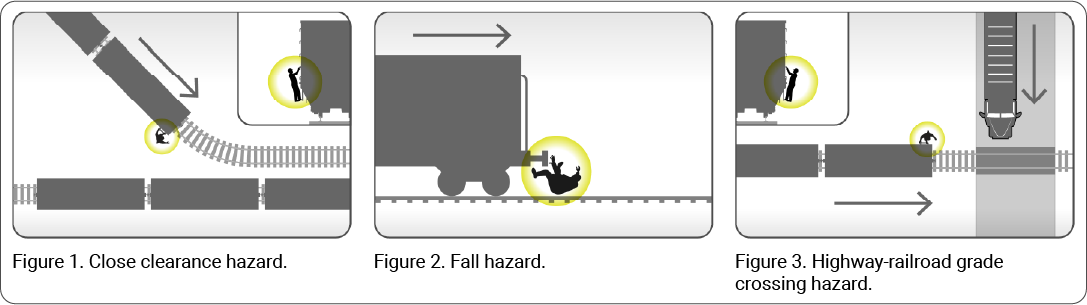
- Shoving movements that pass through close clearances can pin or crush conductors against rail equipment, buildings, and other objects. (See figure 1.) Close clearances are common near buildings and switches, between close-set yard tracks, and at loading docks. Some close clearances, like those created by stored equipment, are temporary and may not be marked or documented.
- When positioned on lead railcars, conductors can fall into a train’s path, and some railcars increase this risk by not enabling secure riding positions. (See figure 2.)
- Slack action can surprise conductors with sudden forces during changes in speed and cause falls. Slack action is the amount of free movement between connected railcars before one railcar transmits its motion to the next. This movement is a result of the couplers and draft systems used in freight trains, which are designed to connect railcars securely, manage forces during train operations, and allow limited motion between railcars to absorb shocks and reduce stress on railcar components.
- When riding shoving movements through highway-railroad grade crossings, conductors can be struck by highway motor vehicles. (See figure 3.) This risk is common in industry yards, where highway-railroad grade crossings often lack gates and active warning lights.
Related investigations
Safety Alert Section Content 3 Five recent investigations highlight the dangers of riding trains during shoving movements. In these accidents, conductors were killed as a result of colliding with highway motor vehicles at a grade crossing, falling into the path of a train, riding through a close clearance, or being caught between colliding trains.
Safety Alert Section Content 5 On March 7, 2023, a Norfolk Southern Railway conductor was killed when his train collided with a dump truck as it entered a private highway-railroad grade crossing in the Cleveland-Cliffs Incorporated steel plant in Cleveland, Ohio. The conductor was riding the lead railcar during a shoving movement and was pinned between the railcar and the dump truck during the collision. (RRD23LR007)
Safety Alert Accordion Header Title On June 26, 2023, a CSX Transportation (CSX) conductor trainee was killed while riding the lead railcar during a shoving movement at Seagirt Marine Terminal in Baltimore, Maryland. The conductor trainee was in an unstable riding position and fell from an intermodal railcar when a change in speed resulted in slack action. He was then struck by the train he had been riding. (RRD23FR012)
Safety Alert Accordion Title 1 On August 6, 2023, a CSX conductor trainee was killed during switching operations at the CSX railyard in Cumberland, Maryland. The conductor trainee was riding on the side of a railcar during a shoving movement that passed through a temporary close clearance location, a narrow space between his train and three locomotives stored on an unusually close adjacent track. During this movement, he was caught in the 7-inch gap between the railcar he was riding and an adjacent locomotive handrail. (RRD23FR016)
Safety Alert Accordion Title 2 On July 6, 2024, a Union Pacific Railroad conductor was killed while riding a train during a shoving movement in Proviso Yard in Melrose Park, Illinois. At the time of the accident, the conductor’s train was traveling west along a converging track toward a switch. At the same time, another train was traveling west toward the same switch along the tangent (straight) track. The conductor, positioned on the leading end of a tank car, was caught between the trains when they collided. (RRD24LR013)
Safety Alert Accordion Title 3 On June 9, 2025, a Union Pacific Railroad conductor was killed during switching operations at the Nacogdoches Yard in Nacogdoches, Texas. Shortly before the accident, the involved crew set out a cut of railcars on the main track north of a switch, positioning them so that the southernmost railcar fouled an adjacent yard track. Later, when the conductor rode the lead railcar during a shoving movement through the switch onto this yard track, his train sideswiped the southernmost railcar. The conductor was struck in the collision. (RRD25FR013)
RRD23LR007
On March 7, 2023, a Norfolk Southern Railway conductor was killed when his train collided with a dump truck as it entered a private highway-railroad grade crossing in the Cleveland-Cliffs Incorporated steel plant in Cleveland, Ohio. The conductor was riding the lead railcar during a shoving movement and was pinned between the railcar and the dump truck during the collision. (RRD23LR007)
RRD23FR012
On June 26, 2023, a CSX Transportation (CSX) conductor trainee was killed while riding the lead railcar during a shoving movement at Seagirt Marine Terminal in Baltimore, Maryland. The conductor trainee was in an unstable riding position and fell from an intermodal railcar when a change in speed resulted in slack action. He was then struck by the train he had been riding. (RRD23FR012)
RRD23FR016
On August 6, 2023, a CSX conductor trainee was killed during switching operations at the CSX railyard in Cumberland, Maryland. The conductor trainee was riding on the side of a railcar during a shoving movement that passed through a temporary close clearance location, a narrow space between his train and three locomotives stored on an unusually close adjacent track. During this movement, he was caught in the 7-inch gap between the railcar he was riding and an adjacent locomotive handrail. (RRD23FR016)
RRD24LR013
On July 6, 2024, a Union Pacific Railroad conductor was killed while riding a train during a shoving movement in Proviso Yard in Melrose Park, Illinois. At the time of the accident, the conductor’s train was traveling west along a converging track toward a switch. At the same time, another train was traveling west toward the same switch along the tangent (straight) track. The conductor, positioned on the leading end of a tank car, was caught between the trains when they collided. (RRD24LR013)
RRD25FR013
On June 9, 2025, a Union Pacific Railroad conductor was killed during switching operations at the Nacogdoches Yard in Nacogdoches, Texas. Shortly before the accident, the involved crew set out a cut of railcars on the main track north of a switch, positioning them so that the southernmost railcar fouled an adjacent yard track. Later, when the conductor rode the lead railcar during a shoving movement through the switch onto this yard track, his train sideswiped the southernmost railcar. The conductor was struck in the collision. (RRD25FR013)
What can conductors do?
Safety Alert Section Title 5 When preparing to protect a shoving movement: - Identify and think about the hazards you will encounter.
- Determine whether walking or using a passenger vehicle is safer than riding the train.
When walking conditions or the yard’s layout make riding the safest option: - Complete a thorough job briefing with all personnel to find ways to avoid or reduce hazards.
- Identify ungated highway-railroad grade crossings and plan to dismount to protect the movement from a safe location on the ground.
- Identify the safer side of the train to ride, keeping yourself away from main tracks and temporary and permanent close clearance locations.
- Get help from a more experienced conductor if you are unfamiliar with a yard, territory, or job. Remember that a map or other job aid might not include all hazards.
When preparing to ride: - Make sure that the track ahead is clear and any switches are lined properly.
- Inspect the railcar’s safety appliances. Do not ride that railcar if they are damaged, missing, or do not allow a stable riding position.
- Find the most secure way to hold on, keeping at least three points of contact. If you do not feel stable and protected from slack action, do not ride.
When riding: - Face the direction of travel, watching for unexpected obstacles such as trains or other equipment on nearby tracks.
- Communicate with your engineer and stay ready for slack action.
- Avoid distractions such as unrelated tasks or unnecessary communications.
What can railroads do?
Safety Alert_Section Title 6 - Provide vehicles, like trucks and carts, and safe walking conditions as an alternative to riding rail equipment.
- Use cameras or other technologies to protect shoving movements without placing employees on or near moving equipment.
- Identify and clearly mark permanent close clearances and close track centers.
- Prohibit riding equipment through ungated highway-railroad grade crossings and in other high-risk locations, such as industry yards not subject to Federal Railroad Administration regulations or railroad operating rules.
- Provide hands-on training on all equipment personnel will encounter and instruct them on what railcars are unsafe to ride and why.
- Provide experienced conductors and trainers to mentor personnel on unfamiliar territories and jobs.
Interested in more information?
Safety Alert Section Content 1 Federal Railroad Administration – Safety Bulletin 2023-04
Switching Operations Fatalities Analysis Group:
|
