Bridges and tunnels make our travels possible and more seamless. When these structures are properly designed, built, and maintained, we don’t give them much
thought. But when a collapse occurs, we are reminded of the magnitude of engineering, construction, and oversight tasks that are required to ensure their integrity and safety.
Although the nation’s bridges and tunnels are extremely safe overall, our investigations of major
structural failures highlight key safety issues and the changes that are needed to prevent
these types of accidents from happening in the future.
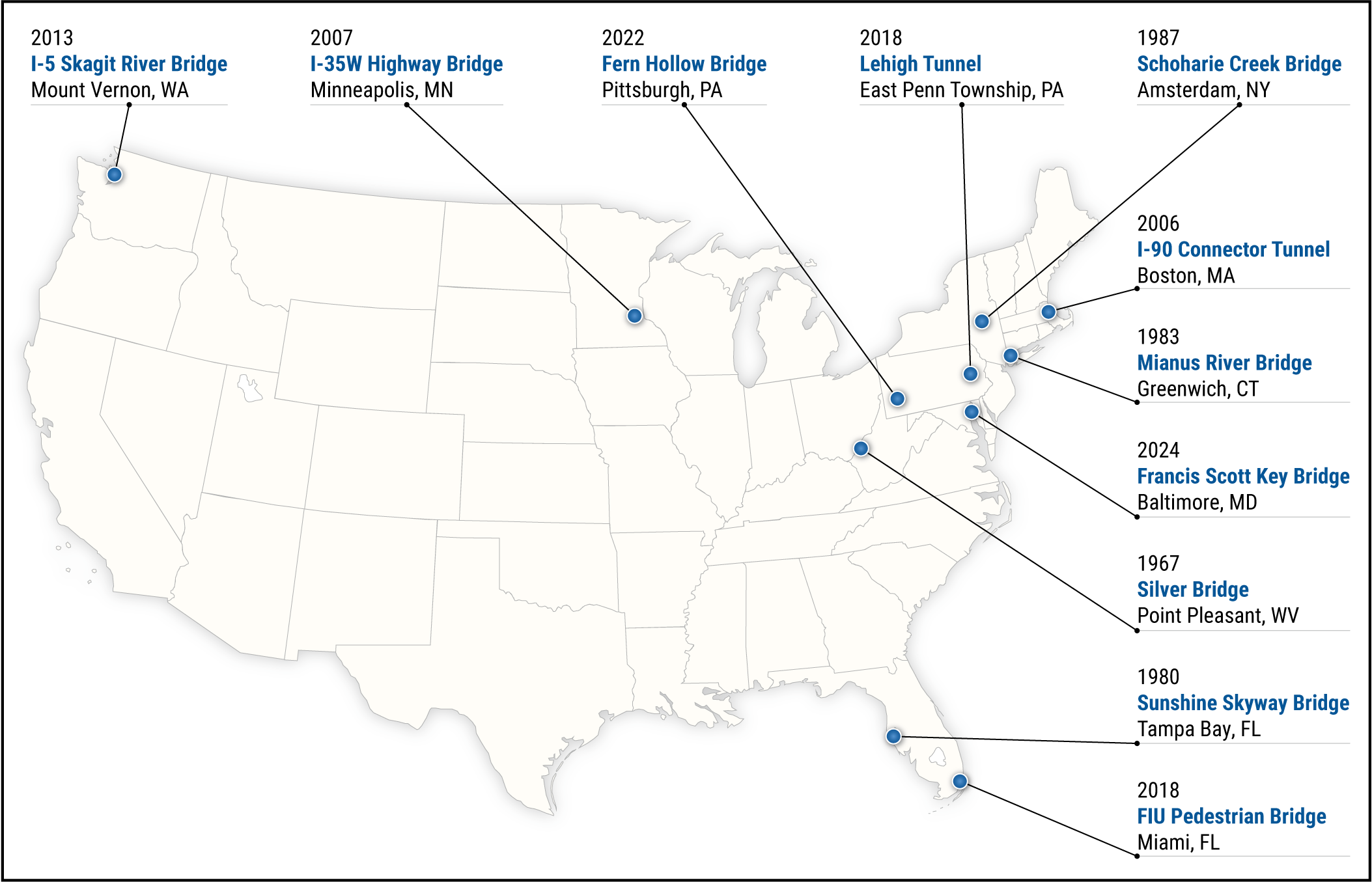
Notable locations where NTSB has investigated a bridge or tunnel infrastructure failure
Infrastructure failures, including bridge and tunnel collapses, have remained one of our primary focus areas since we investigated the 1967 Silver Bridge collapse in West Virginia. The
Silver Bridge collapse and investigation generated nationwide concern about bridge safety and led to the establishment of the National Bridge Inspection Standards by the U.S. Department of Transportation in 1970. These standards set the foundation for systematic bridge oversight.
We continued to see the need to improve infrastructure design, inspection policies, maintenance practices, and safety as we investigated infrastructure failures, such as:
- 1980 Sunshine Skyway Bridge collapse near Tampa Bay, Florida led to the 1991 adoption of the AASHTO Guide Specification and Commentary for Vessel Collision Design of Highway Bridges.
- 1983 Mianus River Bridge collapse in Connecticut, which prompted the Federal Highway Administration, through the National Bridge Inspection Standards, to require a Fracture Critical Member (FCM) inspection.
- 1987 Schoharie Creek Bridge collapse in New York and the collapse of the Hatchie River bridge in Covington, Tennessee, which prompted the Federal Highway Administration, through the National Bridge Inspection Standards, to require a comprehensive underwater inspection.
- 2006 Interstate 90 tunnel ceiling collapses in Boston, which prompted the Federal Highway Administration to develop National Tunnel Inspection Standards in 2008.
Francis Scott Key Bridge Collapse, Baltimore, Maryland
- Contributing to the collapse of the Key Bridge and the loss of life was the lack of countermeasures to reduce the bridge’s vulnerability to collapse due to impact by ocean-going vessels, which could have been implemented if a vulnerability assessment had been conducted by the Maryland Transportation Authority as recommended by the American Association of State Highway and Transportation Officials (AASHTO).
- The Key Bridge was almost 30 times greater than the AASHTO threshold of risk for catastrophic collapse from a vessel collision when the Dali collision occurred.
- Owners of numerous bridges over navigable waterways frequented by ocean-going vessels are likely unaware of their bridges’ risk of catastrophic collapse from a vessel collision and the potential need to implement countermeasures to reduce the bridges’ vulnerability.
Sunshine Skyway Bridge Collapse, Tampa Bay, Florida
- Contributing to the loss of life and to the extensive damage was the lack of a structural pier protection system which could have absorbed some of the impact force or redirected the vessel.
- At the time, there were no federal standards or guidelines for the location and protection of critical bridge piers.
Francis Scott Key Bridge Collapse, Baltimore, Maryland
- Contributing to the loss of life was the lack of effective and immediate communications to notify the highway workers to evacuate the bridge.
- In lieu of police officers or highway workers capable of quickly stopping traffic, motorist warning systems preventing motorists from entering onto a bridge are a critical countermeasure that can save lives and may be a component of an effective bridge protection strategy.
- Owners of bridges over navigable waterways frequented by ocean-going vessels would benefit from updated guidance on motorist warning systems including incorporation of hazard alert and sensing technologies capable of detecting errant vessels and bridge movements that would indicate a need for bridge closure and systems that would both warn and prevent motorists from entering a bridge once a threat is detected.
- Effective and immediate communication to evacuate the bridge during an emergency is critical to ensuring the safety of bridge workers.
Sunshine Skyway Bridge Collapse, Tampa Bay, Florida
- Contributing to the loss of life was the lack of a motorist warning system which could have warned the highway vehicle drivers of the danger ahead.
- Use of a bridge span failure detection and warning system could have saved lives.
Open Recommendations Representing Critical Safety Priorities
H-25-31:To the American National Standards Institute Accredited Standards Committee on Safety in Construction and Demolitions Operations A10:
- Revise ANSI/ASSP A10.47, Work Zone Safety for Roadway Construction to include an effective and immediate means of emergency communications to alert workers performing roadway work on bridges over navigable waterways, which should consider the presence of law enforcement for traffic control.
H-25-30:
To California Department of Transportation, the Golden Gate Bridge Highway and Transportation District, the US Army Corps of Engineers, the Skyway Concession Company LLC, the Louisiana Department of Transportation and Development, the Maryland Transportation Authority, the Mackinac Bridge Authority, the New Hampshire Department of Transportation, the Delaware River Port Authority, the New Jersey Turnpike Authority, the New York State Bridge Authority, the Ogdensburg Bridge and Port Authority, the Seaway International Bridge Corporation, the Thousand Islands Bridge Authority, the Ohio Department of Transportation, the Oregon Department of Transportation, the Rhode Island Turnpike and Bridge Authority, the Texas Department of Transportation, the Washington State Department of Transportation, and the Wisconsin Department of Transportation:
- As part of your short-term bridge risk reduction and mitigation strategies to protect the traveling public, evaluate the need for and, if appropriate, incorporate motorist warning systems capable of activating when a threat is identified and immediately warn and stop motorists from entering onto the bridge. Status: Open – Awaits Response
H-25-29:To the American Association of State Highway and Transportation Officials (AASHTO):
- Update your Guide Specifications and Commentary for Vessel Collision Design of Highway Bridges to include guidance in the selection of motorist warning systems. Evaluated changes should include Federal Highway Administration research on hazard alert and sensing technologies capable of detecting errant vessels and bridge movements that would indicate a need for bridge closure, and would both warn and prevent motorists from entering a bridge once a threat is detected. • Status: Open – Awaits Response
H-25-28:
To the Federal Highway Administration:
- Research hazard alert and sensing technologies capable of detecting errant vessels and bridge movements that would indicate a need for bridge closure, and would both warn and prevent motorists from entering a bridge once a threat is detected. Provide the results of your research to the American Association of State Highway and Transportation Officials.
H-25-3: To the Bay Area Toll Authority, the California Department of Transportation, the Golden Gate Bridge Highway and Transportation District, the US Army Corps of Engineers, the Florida Department of Transportation, the Georgia Department of Transportation, Skyway Concession Company LLC, the Louisiana Department of Transportation and Development, the New Orleans Public Belt Railroad, the Maryland Transportation Authority, the Massachusetts Department of Transportation, the Mackinac Bridge Authority, the New Hampshire Department of Transportation, the Delaware River Port Authority, the New Jersey Turnpike Authority, Metropolitan Transportation Authority Bridges and Tunnels, the New York City Department of Transportation, the New York State Bridge Authority, the Ogdensburg Bridge and Port Authority, the Port Authority of New York and New Jersey, the Seaway International Bridge Corporation, the Thousand Islands Bridge Authority, the Ohio Department of Transportation, the Oregon Department of Transportation, the Pennsylvania Turnpike Commission, the Rhode Island Turnpike and Bridge Authority, the Harris County Toll Road Authority, the Texas Department of Transportation, the Washington State Department of Transportation, and the Wisconsin Department of Transportation:
- Calculate the American Association of State Highway and Transportation Officials (AASHTO) Method II annual frequency of collapse for the bridge(s) identified in appendix B of this report for which you are responsible and inform the National Transportation Safety Board whether the probability of collapse is above the AASHTO threshold. (Urgent) • Status: Open – Acceptable Response
H-25-4:
To recipients of H-25-3
- If the calculations that you performed in response to Safety Recommendation H-25-3 indicate that a bridge has an annual frequency of collapse greater than the American Association of State Highway and Transportation Officials threshold, develop and implement a comprehensive risk reduction plan that includes, at a minimum:
- guidance and assistance from the Federal Highway Administration, US Coast Guard, and US Army Corps of Engineers Interdisciplinary Team identified in Safety Recommendations H-25-1 and H-25-2, and
- short- and long-term strategies to reduce the probability of a potential bridge collapse from a vessel collision.
Summary of Bridge Owner Responses to Safety Recommendations H-25-3 and H-25-4
H-25-2:
To the US Coast Guard and US Army Corps of Engineers
- Support the Federal Highway Administration in establishing an interdisciplinary team—including representatives from Federal Highway Administration, the US Coast Guard, and the US Army Corps of Engineers—and provide guidance and assistance to bridge owners on evaluating and reducing the risk of a bridge collapse from a vessel collision.
H-25-1:
To the Federal Highway Administration
- In coordination with the US Coast Guard and US Army Corps of Engineers, establish an interdisciplinary team—including representatives from FHWA, the US Coast Guard, and the US Army Corps of Engineers—to provide guidance and assistance to bridge owners on evaluating and reducing the risk of a bridge collapse from a vessel collision.
H-24-4:
To the Federal Highway Administration
- Establish a process for conducting targeted reviews of the safety issues identified in the Pittsburgh, Pennsylvania investigation, including at a minimum:
- an evaluation of bridge owners’ determinations of the need for new load ratings of deteriorating bridges, and
- an evaluation of inspection reports on bridges with advanced deterioration to confirm load rating assumptions and methods. Incorporate the results as needed into the National Bridge Inspection Program Compliance Review Manual.
H-20-23:
To the Federal Highway Administration
- Revise your Tunnel Operations, Maintenance, Inspection, and Evaluation Manual; your Specifications for the National Tunnel Inventory; and your inspection training courses to classify significant corrosion in nonstructural tunnel elements, such as overhead electrical distribution systems, as a critical finding that requires immediate action.
H-19-30:
To the American Association of State Highway and Transportation Officials
- Develop a requirement that concrete bridge structures be designed with reasonable estimates for interface shear demand, cohesion and friction contributions to shear capacity, and the clamping force across the interface shear surface.
H-19-24:
To the Federal Highway Administration
- Develop a requirement that concrete bridge structures be designed with reasonable estimates for interface shear demand, cohesion and friction contributions to shear capacity, and the clamping force across the interface shear surface.
H-14-25:
To Nokia HERE and Google Inc.
Develop reliable clearance data for highway structures and incorporate that data into commercial vehicle navigation systems to improve routing and permitting of oversize loads.
Updated December 10, 2025
